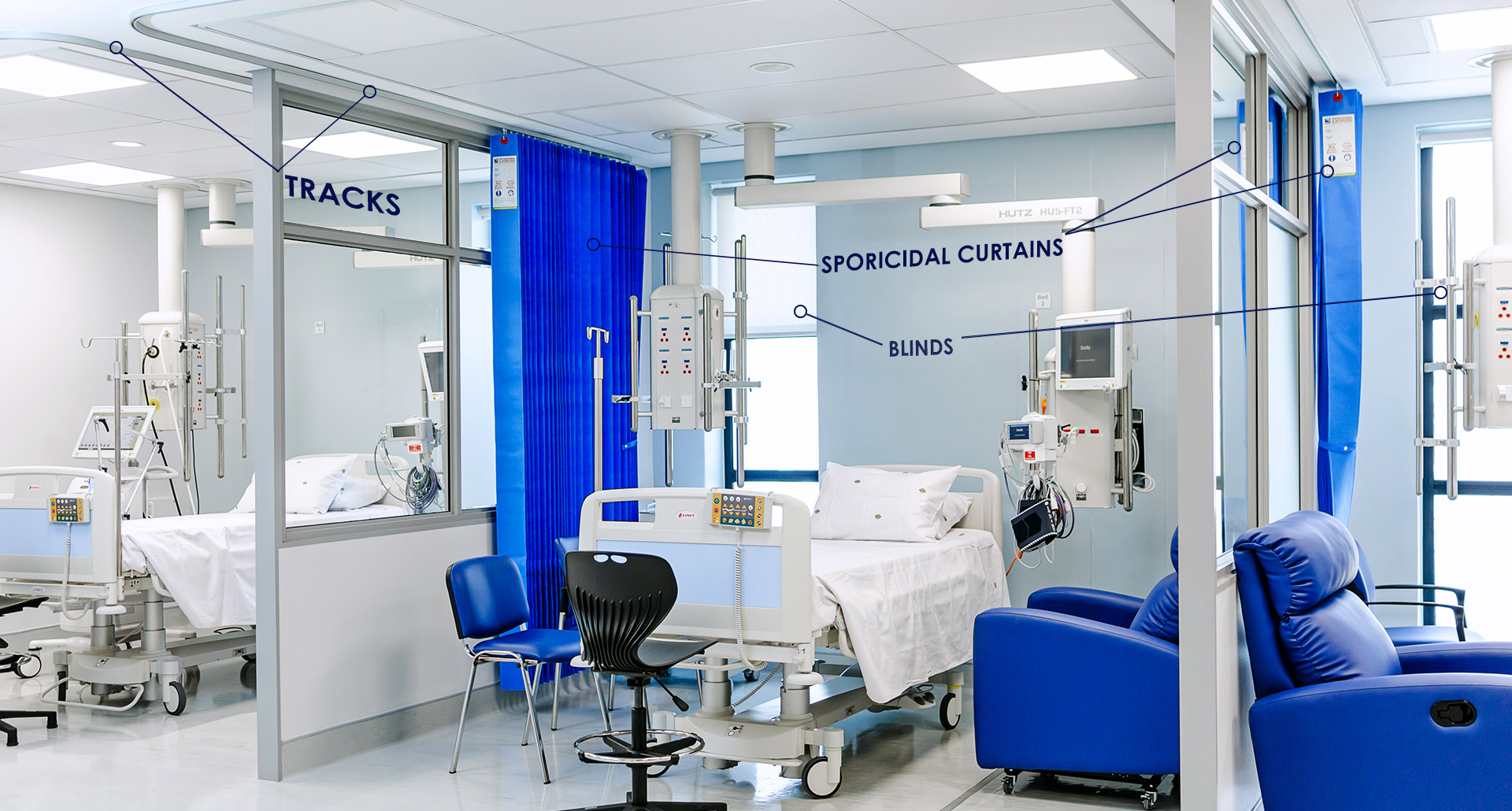
At the curtain manufacturing stage, the polypropylene curtain fabric is impregnated with a combination of our unique, patented Endurocide® Curtain liquid and a flame retardant chemical.
The Endurocide® Curtain liquid coats the fabric with a biostatic polymer layer. If pathogens come into contact with the fabric, the Endurocide® Antimicrobial & Sporicidal layer instantly starts working by trapping the pathogens on the fabric and preventing them from multiplying and being re-transmitted.
Recent studies have shown that traditional hospital “curtains are rapidly contaminated with potentially pathogenic bacteria” and “curtains are a potentially important site of bacterial contamination in hospitals”1.
On top of this, further studies show that pathogens such as MRSA, VRE and C.difficile spores are capable of surviving on surfaces for weeks, meaning that hospital workers can touch these contaminated surfaces and then transmit these pathogens onto patients2.
Traditional polyester curtains, or standard polypropylene curtains that haven’t been treated with an antimicrobial agent can quickly & easily become sources of pathogenic transmission. For example, a healthcare worker who touches the patient could possibly transmit this infection to an object/surface, such as a hospital curtain. If this happens, this object now has the potential to contaminate anyone who comes in contact with the surface. All of this means that traditional Hospital Curtains are a potential source for the spread of healthcare-associated pathogens3.
Endurocide® Antimicrobial & Sporicidal Hospital Curtains were specifically created to help hospitals reduce the potential for this pathogenic transmission to occur from Hospital Curtains and they are therefore effective against the top pathogen groups commonly found in hospitals worldwide:
Spores
Bacteria
Fungi
Mycobacteria
Certain Viruses
Sources:
 This dual mechanism of trapping & killing the pathogens is key. The Curtain fabric traps pathogens on the surface, preventing them from being picked up when the Curtain is touched and then when the pathogens are trapped, the Curtain kills the pathogens, preventing them from multiplying or remaining a risk to users on the Curtain.
Studies have shown that up to 40% of HAIs can be attributed to the cross infection from the hands of health care personnel, who are contaminated either by direct contact with a patient or indirectly by touching contaminated surfaces1. It has also been shown that contaminated hands can transfer viruses to 5 more surfaces2 or 14 other subjects3.
On top of this, pathogens can survive on surfaces for long periods of time, with C.difficile spores and MRSA being shown to survive on surfaces for up to 5 months and 7 months respectively4. It is widely understood that hand hygiene protocols and surface disinfection procedures are essential in minimising the potential for this cross contamination.
However, what about the hospital curtain? What procedures are there to minimise its potential for contamination? If a health care worker touches a contaminated surface and picks up the contamination, then touches a hospital curtain, they have the potential to contaminate the hospital curtain. With some hospital curtains remaining in-situ for anywhere between one day to six months, these hospital curtains have the potential to become sources of transmission of infections for anyone who comes into contact with them.
Until now there was not much that you could do about this. However Endurocide® Antimicrobial & Sporicidal Hospital Curtains have changed this! By being tested and proven to kill spores, bacteria and fungi, Endurocide® Antimicrobial & Sporicidal Hospital Curtains offer an effective barrier to pathogens and help hospitals maintain their hand and surface hygiene protocols – by minimising the potential for the hospital curtain to become a source of infection!
Endurocide® Antimicrobial & Sporicidal Hospital Curtains are ready to work as soon as you take them out of the box and have been independently tested and shown to kill pathogens in seconds.
We have found that there are numerous products on the market that claim to be antimicrobial, but do not define what this means and what exactly the product is capable of doing.
When comparing products, it is very important to understand how an antimicrobial hospital curtain works and how its effectiveness is tested and verified. It is also important to understand that there are different ways that an antimicrobial curtain can work, eg:
Endurocide® Antimicrobial & Sporicidal Hospital Curtains are independently tested and shown to not only trap the pathogens on the fabric, but to also kill them, meaning that the curtains are sporistatic, bacteriostatic, sporicidal and bactericidal:
Sporistatic & Bacteriostatic
These terms refer to whether a curtain is capable of inhibiting the growth and reproduction of spores and bacteria. As our Endurocide® Antimicrobial & Sporicidal Hospital Curtains have been independently tested and shown to be both Sporistatic and Baceteriostatic, our curtains will trap any spores and bacteria that come into contact with the curtain and prevent these pathogens from escaping and being re-transmitted to another surface.
The International Standards to demonstrate that a fabric is Sporistatic and Bacteriostatic are AATCC 147 & GC 147. These tests are qualitative tests, in that they evaluate the fabric’s antimicrobiality.
Sporicidal & Bactericidal
This means that the curtain is capable of actually killing the spores and the bacteria on the surface of the curtain, preventing them from multiplying and becoming a source of transmission.
The International Standards to demonstrate that a fabric is Sporicidal and Bactericidal are AATCC 100 and JIS Z 2801. These tests are quantitative tests, in that the number/reduction of bacteria on the curtain is counted.

Although we refer to the Endurocide® Antimicrobial & Sporicidal Hospital Curtains as being primarily Sporicidal & Antimicrobial, it is important to understand that in order for the curtain to be truly effective, it must have been tested and shown to be both Sporistatic & Bacteriostatic as well as being Sporicidal & Bactericidal.
As far as we are aware, Endurocide® Antimicrobial & Sporicidal Patented Hospital Curtains are the only curtains available on the market that can claim this!
All Endurocide® Curtains should be stored at ambient temperatures (i.e. 25°C max) and out of UV light.
Polypropylene remains stable for approximately 12 months (if stored as above), but after this time will start to gradually degrade. This degradation process will occur at a faster rate in the presence of warm/high temperatures, humid conditions and most importantly in the presence of UV light.
No: it is not advised to clean any of our curtains by any mechanical means – disposable curtains are designed to be replaced when visibly soiled. Regarding Endurocide® Antimicrobial & Sporicidal Curtains, wiping or cleaning them may affect the performance of the patented sporicidal formulation coated onto the curtain surface. The curtains are designed to kill pathogens in situ and do not require any cleaning to improve function. When any of our curtains become visibly soiled, they should always be replaced.
It is advised that Endurocide® Antimicrobial & Sporicidal Curtains are not placed in areas where they are exposed to prolonged direct sunlight.
Although the curtains will still be effective against pathogens, the polypropylene material the curtains are made from is not UV resistant and may suffer accelerated ageing as a result. This will lead to a loss in tensile strength and elasticity of the curtains. This will become visible as “pilling”. This is caused by the fibres in the polypropylene becoming brittle with UV exposure and coming loose from the main fibre chains and breaking down.
This effect is normally only observed after several months in direct sunlight.
Both of our Endurocide® Hospital Curtains will fit most popular track systems as we supply in four different hanging systems:
1: UNIVERSAL EYELETS
Works with existing systems and hooks (no hooks supplied).
2: QUICK-FIT
Comes complete with standard one-piece hooks, designed to fit in most rail systems.
3: U-TYPE*
Designed to fit on existing track systems.
4: WHEELED HOOK*
Includes integral wheels for smoother movement (two widths available)

*Available on request – MOQs may apply.
No: Whilst Endurocide® Antimicrobial & Sporicidal Curtains have been independently tested to remain antimicrobially and sporicidally effective for up to two years in-situ, the actual length of curtain use achieved will depend on a variety of factors including, but not limited to; individual hospital practices, the natural longevity of polypropylene and the risk of the curtain being soiled from items such as blood, urine and general spills etc. Curtains should always be replaced when visibly soiled.
Any timescales provided/referenced are always offered as a guideline only and under no circumstances whatsoever constitute a guarantee.
All our Endurocide® Curtains are made from 100% polypropylene which has a very low environmental impact when compared with other types of synthetic or traditional materials.
In addition, the liquid used to impregnate our Endurocide® Antimicrobial & Sporicidal Curtains is water-based.
Endurocide Curtains are available in the following pack sizes:
| Standard | Long drop | Meshtop | Meshcut |
| Case of 6 | Case of 5 | Case of 5 | Case of 5 |
| Case of 8 | Case of 7 | Case of 7 | Case of 7 |
| Case of 12 | Case of 10 | Case of 10 | Case of 10 |